Pregnancy does not automatically rule out an operation, but it changes how doctors judge urgency, timing, anaesthesia and hospital support. By the end, you will know which symptoms need immediate assessment, when observation or postponement is reasonable, and what to ask before planned surgery.
Key takeaways
- Seek same-day assessment for severe or worsening abdominal pain.
- Trimester, diagnosis, urgency, and fetal assessment guide timing.
- Ask whether an ovarian cyst can be monitored or needs removal.
- Choose a team experienced in pregnancy, anaesthesia, laparoscopy, and fetal care.
When pregnancy makes laparoscopic surgery urgent
Severe or worsening abdominal pain in pregnancy needs same-day hospital assessment, not a routine laparoscopic appointment. Go urgently for fainting, vaginal bleeding, shoulder-tip pain, fever, persistent vomiting, abdominal rigidity, reduced fetal movement, or signs of shock.
The operation is considered when delaying treatment threatens the mother or pregnancy more than surgery does. Suspected ectopic pregnancy with pain, bleeding, internal haemorrhage, or instability is an emergency; laparoscopy can diagnose and treat it, but it cannot preserve an ectopic pregnancy.
Ovarian torsion, appendicitis, acute cholecystitis, sepsis, and an enlarging or suspicious adnexal mass also need prompt surgical assessment.
| Condition | Why waiting is dangerous | Usual urgent response |
|---|---|---|
| Suspected ectopic pregnancy | Rupture can cause life-threatening internal bleeding | Emergency ultrasound, blood tests and surgery when indicated |
| Ovarian torsion | Loss of blood supply can destroy the ovary | Prompt imaging and detorsion or removal |
| Appendicitis or cholecystitis | Perforation, infection and preterm complications can follow | Antibiotics, surgical review and operation when required |
| Suspicious or rapidly enlarging mass | Cancer risk, rupture or torsion may increase | Specialist imaging and planned or urgent removal |
A necessary operation should not be postponed solely because you are pregnant. The safest approach depends on diagnosis, gestational age, stability and hospital capability; open surgery is chosen when it offers better control or laparoscopy is unsafe.
If you search “when is laparoscopic surgery during pregnancy for considered Pune” or “laparoscopy during pregnancy Pune”, choose a hospital with 24-hour obstetric cover, pregnancy-experienced anaesthesia, fetal assessment, blood-bank support and neonatal care.
How the trimester changes planned surgery decisions
The second trimester is often preferred for planned, medically necessary surgery because organ formation has largely finished, while the uterus is usually still small enough to allow surgical access. Waiting for this window can reduce technical difficulty, but it is not a reason to delay dangerous disease.
In the first trimester, treatment should proceed when waiting creates greater danger than operating, including:
- Ectopic pregnancy or internal bleeding
- Ovarian torsion
- Appendicitis
- Acute gallbladder inflammation
- A suspicious or enlarging mass that cannot safely wait
A necessary operation should not be postponed solely to reach the second trimester. The team weighs the risks of anaesthesia, pregnancy loss, infection, bleeding and worsening maternal illness.
In the third trimester, urgent treatment also proceeds without waiting for delivery when infection, bleeding, torsion or obstruction threatens the mother or pregnancy. Stable, non-urgent procedures are usually deferred until after birth, especially when symptoms remain controlled and imaging is reassuring.
If you are searching for “laparoscopy during pregnancy Pune”, ask whether the proposed hospital provides 24-hour obstetric cover, anaesthesia from clinicians experienced with pregnancy, fetal assessment, blood-bank support and neonatal care suited to the gestational age. A planned operation needs coordination between the surgeon, obstetrician and anaesthetist, not simply a preferred trimester.
When an ovarian cyst can be watched and when it needs removal
A thin-walled, fluid-filled, single-chamber cyst with no solid nodule or papillary projection usually supports ultrasound surveillance when you have no pain. Doppler blood flow alone does not prove cancer; the whole appearance, your symptoms and the scan trend matter.
Size changes the level of review, not the decision by itself. A cyst under 5 cm is often observed, while one measuring 5–10 cm needs individual assessment; a mass over 10 cm usually warrants specialist planning because torsion and malignancy concerns rise.
A cyst that enlarges, remains after the first trimester or develops solid areas, thick irregular septa, papillary projections or ascites needs prompt reassessment.
- Observation: repeat ultrasound at an agreed interval when the mass looks benign, remains stable and causes no significant symptoms.
- Medical treatment: medicines can control pain, nausea or dehydration, but they do not dissolve most ovarian cysts during pregnancy. Do not self-medicate; use pregnancy-safe treatment advised by your clinician.
- Removal: surgery becomes more likely for persistent growth, severe or recurring symptoms, obstruction, rupture, suspected cancer or an appearance that cannot be safely classified.
Sudden one-sided pain, vomiting, fainting, fever or abdominal rigidity requires emergency assessment. Ovarian torsion can cut off the ovary’s blood supply, so waiting for the cyst to resolve is unsafe; suspected malignancy also requires planned surgical review rather than observation alone.
What changes when laparoscopy is performed on a pregnant patient
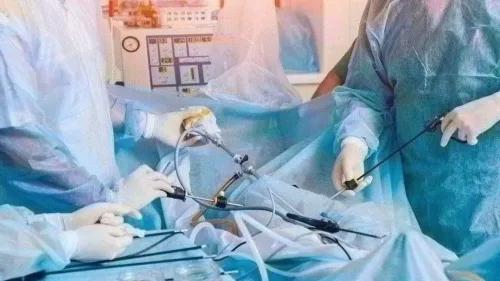
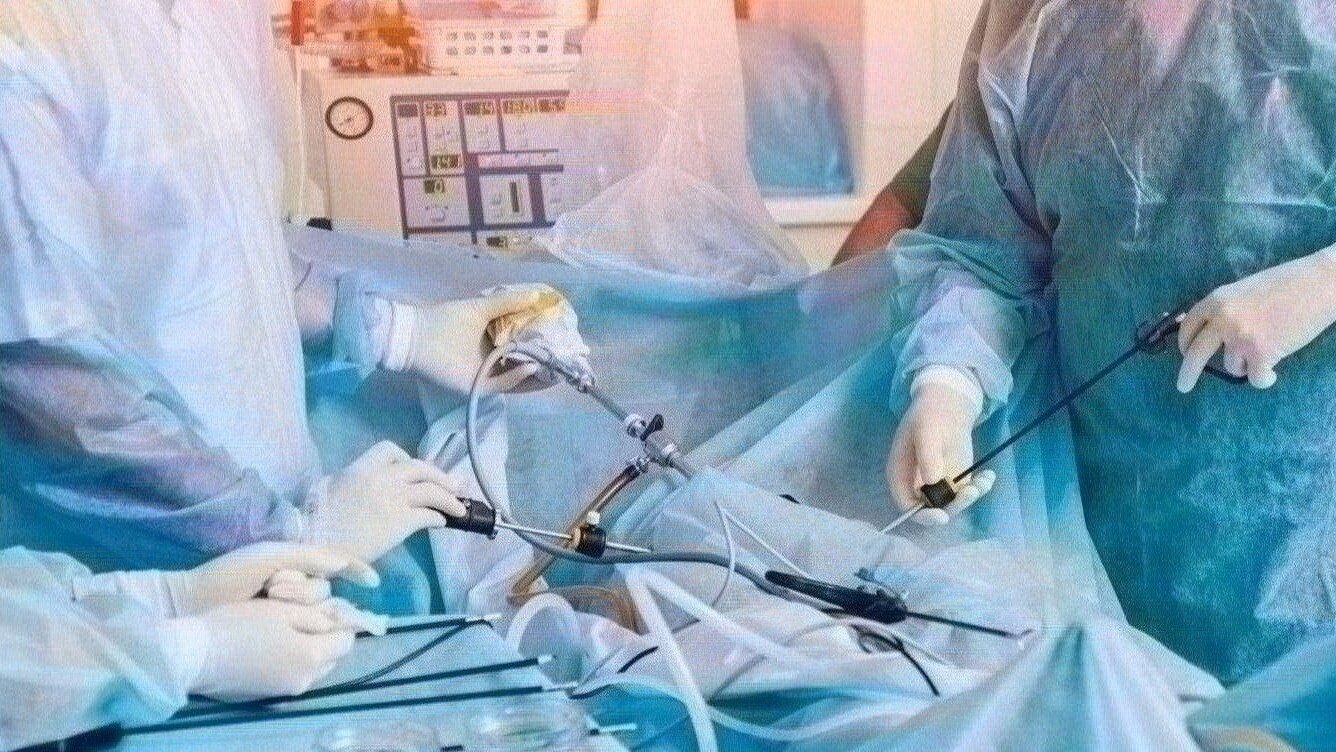
Laparoscopy is not automatically safer than open surgery during pregnancy; the better choice depends on the diagnosis, gestational age, uterine size and team’s experience. Keyhole surgery uses carbon-dioxide insufflation and trocars placed around an enlarging uterus, so entry must be planned with ultrasound, prior-scar review and careful positioning.
| Approach | Main advantages | Main concerns |
|---|---|---|
| Laparoscopy | Smaller incisions, less wound pain, shorter recovery and hospital stay | Limited working space, trocar or uterine injury, carbon-dioxide effects, longer operating time in difficult anatomy |
| Open surgery (laparotomy) | Direct access, rapid control of major bleeding and easier removal of a large or suspicious mass | Larger incision, more pain, slower recovery, wound complications and greater risk of postoperative adhesions |
The anaesthetist must protect oxygenation and blood pressure while accounting for pregnancy-related airway changes, aspiration risk, reduced lung reserve and venous compression from the uterus. Positioning, insufflation pressure, temperature, fluid balance and clot prevention require active management; bleeding, uterine contractions, preterm labour and fetal compromise remain pregnancy-specific risks.
A hospital assessing pregnancy laparoscopic surgery Pune should provide coordinated input from the surgeon, obstetrician and pregnancy-experienced anaesthetist. Fetal heart-rate assessment is commonly performed before and after surgery when feasible. Intraoperative monitoring is considered when the fetus is viable, monitoring is possible and the team can respond, including urgent delivery.
Ask about 24-hour obstetric cover, blood-bank access and neonatal support before choosing care.
How to choose the right hospital and surgical team in Pune
Choose a hospital, not just a surgeon’s procedure list. The phrase laparoscopic surgeon for pregnant women pune is not a substitute for a coordinated review by the operating surgeon, an obstetrician and an anaesthetist experienced with pregnancy.
| Verify | What adequate cover looks like | Why it matters |
|---|---|---|
| Obstetrics | An obstetrician available 24 hours, including during surgery | Bleeding, contractions or preterm labour need immediate treatment |
| Anaesthesia | An anaesthetist who regularly manages pregnant patients | Pregnancy changes airway, breathing, circulation and medication decisions |
| Fetal assessment | Ultrasound and fetal heart-rate assessment before and after surgery when feasible | The team needs a baseline and a way to detect deterioration |
| Neonatal care | Blood-bank support and neonatal services suited to the gestational age | Fetal compromise or early delivery can require rapid escalation |
| Emergency planning | A documented response to bleeding, fetal compromise and preterm labour | A clinic without operating-room and obstetric backup is a poor choice |
Ask who will monitor the fetus, whether intraoperative monitoring is technically possible, and whether an obstetric professional can act on an abnormal result. Confirm the trocar-entry plan and intended insufflation pressure, since the growing uterus changes surgical access.
When comparing Dr. Mahindra Borse - Laparoscopic and Gynaec Endoscopic Surgeon in Pune with another specialist, ask for the precise indication, alternatives, and the hospital where the operation will occur. Do not delay hospital assessment for severe pain, fainting, fever, bleeding or reduced fetal movement.
Related services
Laparoscopic surgery in Pregnancy Laparoscopic surgery in Pregnancy Laparoscopic surgery in pregnant women significantly reduces hospitalization, reduces narcotic use, and quickens the return to a normal diet when... View service → |
Emergency Laparoscopy in Pune Lap for twisted Ovarian cysts Lap TO masses – Acute PID Lap hemoperitoneum – Ruptured Corpus luteum cysts etc Lap ruptured Endometriomas Lap for Post... View service → |
Frequently asked questions
When does pregnancy make laparoscopic surgery urgent?
Urgent assessment is needed for severe or worsening abdominal pain, fainting, vaginal bleeding, shoulder-tip pain, fever, persistent vomiting, abdominal rigidity, reduced fetal movement, or signs of shock.
How does the trimester affect planned laparoscopic surgery?
The surgical team considers the trimester, the condition being treated, the urgency of surgery, anaesthesia, fetal assessment, and the risks of delaying treatment.
When does an ovarian cyst need removal during pregnancy?
A cyst may be monitored when its appearance, size, symptoms, and pregnancy-related risks support observation. Removal is considered when pain, torsion, rupture, suspicious features, or continued growth makes treatment safer than waiting.
What should you ask a Pune hospital before laparoscopy during pregnancy?
Ask about the surgeon’s experience with pregnancy laparoscopy, anaesthesia support, fetal assessment, emergency access, operating facilities, and coordination with obstetric and neonatal teams.